PAUT is taking over
At Libellum Testing & Inspection Ltd, we have seen first-hand how PAUT consistently outperforms conventional radiography in operational efficiency, safety, and defect detection capability. With a proven track record delivering advanced NDT solutions across critical industries, Libellum continues to support clients in reducing downtime, improving quality assurance, and maintaining the highest safety standards.
Understanding the Difference
What is Radiographic Testing (RT)?
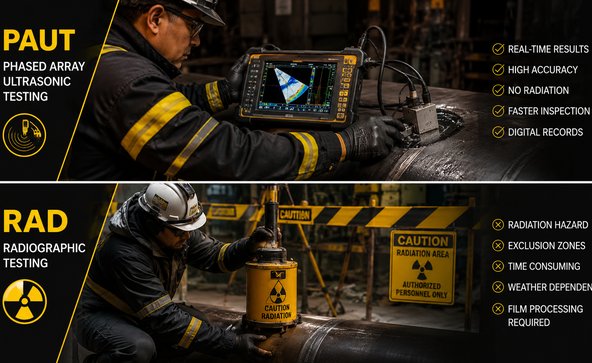
Radiographic Testing uses X-rays or gamma rays to create an image of a weld or component onto film or digital media. This method has been widely used for decades and remains recognised within many industry codes and standards.
RT is effective for detecting volumetric defects, however, traditional radiography also comes with significant operational limitations.
What is Phased Array Ultrasonic Testing (PAUT)?
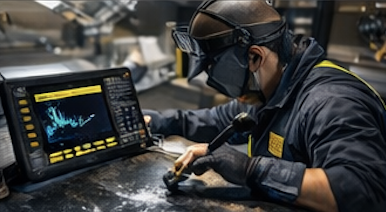
PAUT is an advanced ultrasonic inspection technique that uses multiple electronically controlled ultrasonic beams to scan materials from various angles simultaneously.
Unlike conventional ultrasonics, PAUT provides:
* Real-time imaging
* Precise defect sizing
* Digital scan recording
* Greater inspection coverage
* Improved defect characterisation
PAUT can identify both volumetric and planar defects with exceptional accuracy, making it one of the most versatile NDT methods available today.
Why Industry is Moving Toward PAUT
1. Superior Safety
One of the biggest drawbacks of radiography is radiation exposure.
RT requires:
* Controlled exclusion zones
* Radiation monitoring
* Site evacuations
* Strict legislative controls
* Additional safety personnel
On busy fabrication sites or offshore environments, these restrictions can severely impact productivity.
PAUT eliminates radiation hazards entirely.
Because PAUT uses sound waves instead of ionising radiation:
* No exclusion zones are required
* Nearby work can continue uninterrupted
* Reduced risk to personnel
* Easier integration into live production environments
For many clients, the safety advantage alone makes PAUT the preferred inspection method.
2. Faster Inspection Times
Time is critical in fabrication and shutdown environments.
Radiography often involves:
* Film setup
* Exposure time
* Film processing
* Interpretation delays
* Repeat shots if quality is poor
PAUT provides immediate results in real time.
Inspectors can:
* Scan faster
* Interpret data instantly
* Identify repairs immediately
* Reduce production hold points
This dramatically shortens inspection turnaround times and allows projects to progress without unnecessary delays.
At Libellum, our experienced PAUT personnel routinely help clients minimise downtime and maintain aggressive project schedules without compromising inspection integrity.
3. Reduced Overall Costs
While some organisations initially view PAUT equipment as a larger investment, the operational savings are substantial.
PAUT reduces costs through:
* Faster inspections
* Less downtime
* Reduced manpower requirements
* No radiation shutdowns
* Elimination of film and chemical processing
* Lower repeat inspection rates
Radiography can become particularly expensive on complex or congested sites where work stoppages affect multiple trades simultaneously.
PAUT allows surrounding operations to continue, reducing indirect project costs significantly.
4. Better Defect Detection and Sizing
One area where PAUT truly excels is defect characterisation.
Radiography provides a 2D image which can sometimes struggle to accurately identify:
* Crack depth
* Lack of fusion
* Tight planar defects
* Defect orientation
PAUT delivers highly detailed cross-sectional imaging, allowing inspectors to:
* Precisely size defects
* Locate discontinuities accurately
* Assess severity more effectively
* Improve repair decision-making
This results in:
* Greater confidence in inspection findings
* Improved quality control
* Fewer unnecessary repairs
* Better long-term asset integrity
In critical applications such as pressure vessels, structural welds, stainless fabrication, and offshore components, this level of accuracy is invaluable.
5. Full Digital Traceability
Modern quality systems increasingly demand traceability and data retention.
PAUT provides:
* Fully digital scan records
* Permanent data storage
* Scan replay capability
* Enhanced reporting quality
* Easier auditing and client review
Compared to traditional film radiography, digital PAUT data offers far greater transparency and long-term accessibility.
For companies operating under ISO 9001 and ISO 17020 aligned quality systems, this is a major operational benefit.
Is Radiography Still Relevant?
Radiography still has its place within industry and remains specified by certain codes, standards, and client requirements. In some applications, RT may still be preferred for:
* Thin wall materials
* Certain casting inspections
* Legacy project specifications
* Specific code compliance requirements
However, in many modern fabrication and in-service inspection environments, PAUT is increasingly becoming the more practical and effective solution.
The Future of Inspection
As industries continue to prioritise safety, efficiency, and digital quality assurance, PAUT is rapidly becoming the leading choice for advanced weld inspection.
Its ability to deliver:
* Faster results
* Improved safety
* Lower operational costs
* Enhanced defect detection
* Complete digital traceability
makes it one of the most valuable NDT technologies available today.
At Libellum, we continue to invest in advanced inspection capabilities and highly competent personnel to ensure our clients receive reliable, accurate, and efficient NDT solutions tailored to modern industry demands.
Whether supporting fabrication projects, shutdowns, offshore scopes, or critical infrastructure inspections, Libellum has a proven track record in delivering high-quality PAUT services that help clients maintain compliance, improve safety, and protect asset integrity.
Looking for Advanced PAUT Inspection Support?